Evaluate the workflow, not the homepage
An AI influencer generator is easy to judge from a polished gallery and harder to judge from the work required to produce it. A useful evaluation tests whether the tool supports your real process: keeping one persona recognizable, creating scene variety, reviewing imperfect outputs, understanding rights, and predicting what approved assets will cost.
The goal is not to find a universal winner. A solo creator, a campaign team, and an operator managing several virtual personas may value different controls. Define the job before comparing products.
Start with a written use case
Write a short brief that every tool must attempt. Include the type of persona, the media you need, the intended channels, the people who approve outputs, and the expected production cadence. Keep the brief free of sensitive personal data and use only source material you are authorized to upload.
A practical brief might ask for one fictional adult creator in a portrait, an indoor lifestyle scene, an outdoor scene, and a product-neutral social image. The purpose is not to create a perfect portfolio. It is to expose how the identity responds when pose, framing, lighting, and environment change.
1. Test recognizable identity continuity
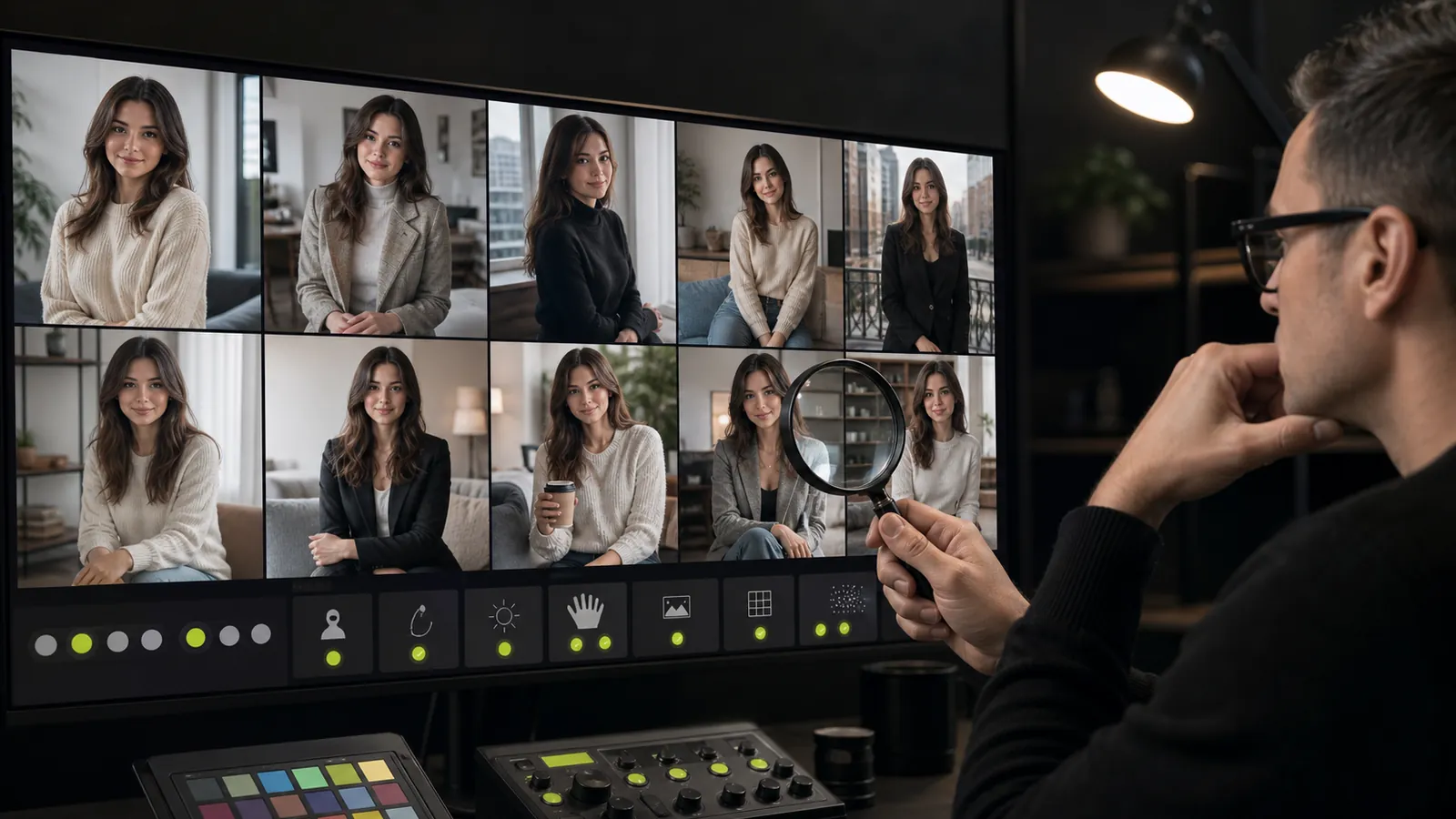
Character continuity is the central test for an AI influencer workflow. Generate several outputs from the same creator configuration and approved reference, then compare face shape, distinctive features, hair direction, apparent age, body proportions, and overall visual direction. Look at the full set, including weaker generations, rather than selecting only the closest match.
Repeat at least one scene with the same settings. Generative systems vary, so the relevant question is whether the workflow helps you produce and select a recognizable series—not whether every image is identical. The guide to AI character consistency explains why repeatable configuration and human review matter.
2. Inspect image quality beyond the first glance
Review each output at the size you will actually publish. Check facial details, hands, edges, reflections, text-like artifacts, object continuity, lighting direction, and whether the subject fits naturally into the scene. A striking thumbnail can still require cleanup at full resolution.
- Check close portraits and wider compositions.
- Include seated, standing, and partially occluded poses.
- Test simple and complex backgrounds.
- Record whether you would approve, revise, or discard each output.
3. Measure the creation and review workflow
Count the steps from reference to approved output. Note whether the tool relies on long prompts, structured controls, scene references, presets, or a combination. None is automatically better; the useful method is one your team can repeat without losing the creator’s visual direction.
Inspect the review loop. Can you organize outputs by creator, compare variations, identify the settings used, and avoid mixing assets from different identities? Is credit use clear before an operation starts? Browse Fanerse’s current reference poses and scenes as one example of a reference-led approach.
4. Verify that advertised capabilities are available
Separate live functions from beta features, roadmap statements, and marketing concepts. If you need image-to-video, collaboration, publishing, an API, or a particular export, test that exact path before treating it as part of the decision. A checkmark or future-facing description is not an end-to-end product test.
Use the product UI and current documentation as evidence. If a capability is plan-dependent, confirm which plan exposes it and what limits are shown before the operation. The Fanerse comparison hub can support a methodology, but it does not replace testing the products relevant to your decision.
5. Review rights, consent, privacy, and safety
An evaluation is incomplete if it looks only at visual quality. Read what rights you must hold in an uploaded reference, how real-person likeness is handled, what content is prohibited, and what reporting path exists. Confirm the rules concerning adults, consent, and deceptive uses.
Ask how references and generated assets are stored, who can access them, and what deletion controls are offered. Do not upload confidential material or unauthorized likenesses simply to test quality. Fanerse’s current requirements are in its Content Policy; review the terms and privacy information before production use.
6. Calculate workflow cost, not headline price
Subscription price alone does not reveal production cost. Record included credits, the cost of each operation you use, creator limits, media restrictions, renewal behavior, and whether unused credits carry forward. Estimate cost per approved asset from your test—not cost per generation—because repeated or discarded outputs are part of the workflow.
Verify commercial details against the current checkout and terms. Do not rely on an old article for refunds, cancellation, credits, or plan availability. Fanerse maintains current plan information on its pricing page.
7. Check export and operational fit
Confirm file formats, dimensions, the download process, and any visible marks or metadata that affect your intended channel. Test how you will name files, track approvals, preserve evidence of source rights, and distinguish AI-generated media in your library. If another person reviews content, test that handoff rather than assuming it works.
A reusable evaluation scorecard
| Area | Evidence to collect | Decision question |
|---|---|---|
| Identity continuity | Full output set across controlled scene changes | Can reviewers recognize one intended persona without cherry-picking? |
| Image quality | Full-resolution inspection and approval notes | How much revision or discarding is required? |
| Workflow | Steps, settings, time, and organization method | Can the intended operator repeat the process? |
| Availability | End-to-end tests for required features | Is the capability live on the relevant plan? |
| Rights and privacy | Current policy, terms, storage, and deletion controls | Can the project use the tool responsibly? |
| Cost | Plan terms, credits consumed, outputs approved | What is the cost of usable content? |
| Export | Downloaded files tested in the destination workflow | Do the assets fit the production process? |
Run the same short test everywhere
- Prepare one authorized reference and a written, SFW test brief.
- Define four scene changes and quality checks before generating.
- Use the same approval criteria for every tool.
- Record every attempt, not only the outputs you like.
- Verify required features, plan terms, policies, and exports directly.
- Choose from the complete workflow and retain the scorecard for retesting.
A reproducible evaluation lets another reviewer understand what you tested, what you observed, and why the result fits your use case.
Applying the checklist to Fanerse
Fanerse is designed around authorized references and identity-guided generation across poses and scenes. That makes recognizable continuity and the reference-led workflow the first things to test. Results still vary, and each output should be reviewed before use.
Start with the Fanerse AI influencer generator, use the controlled scenes above, and record successful and rejected outputs. That evidence is more useful than a generic “best tool” list because it shows whether the current product fits your actual creator workflow.