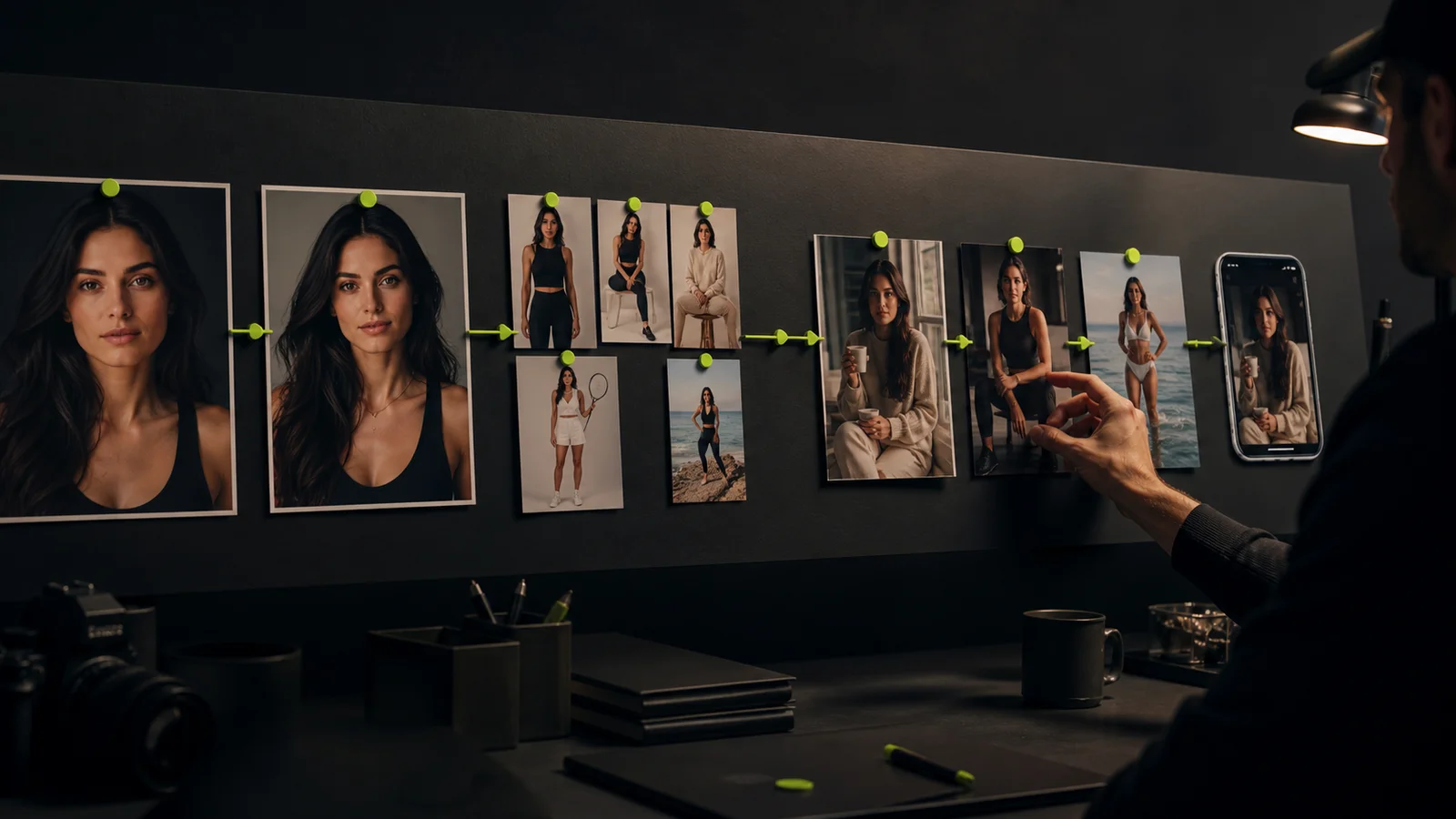
A digital persona is the identity your audience encounters across images, captions, videos, and replies. A face is one part of it. The name, point of view, language, and recurring subjects also need to make sense together.
This guide focuses on editorial consistency: how to keep a character recognizable when different posts, formats, and collaborators are involved. For the initial visual setup, start with AI persona design. Here, the deliverable is a working persona document that another person can use without guessing.
Give the persona a clear role
Write one sentence explaining what the character contributes. For example: “A fictional city-style creator who explains how a small wardrobe works across everyday settings.” That sentence is an illustrative brief, not a claim about a real person.
Now define the audience and the useful recurring formats. A styling persona might publish outfit breakdowns, scene variations, and short explanations of a visual choice. A character trying to cover fashion, investing, health advice, and breaking news at once will need far more editorial judgment than the initial face design suggests.
Decide what the persona does not know or discuss. A scope boundary makes it easier to reject a caption that sounds polished but does not belong to this character.
Build a one-page identity document
| Element | What to record | Example decision |
|---|---|---|
| Name | Exact spelling and approved handle | One spelling across every channel |
| Visual identity | Approved references and stable traits | Keep facial structure and hairstyle consistent |
| Voice | Tone, sentence length, and vocabulary | Short explanations with concrete examples |
| Subjects | Recurring themes and boundaries | Styling choices and creative process |
| Transparency | How the fictional or synthetic identity is described | A clear profile description and suitable post labels |
| Review | Who approves changes | One named editorial owner |
Use actual examples beside the rules. “Confident” can mean very different things to two writers. An approved caption and a rejected caption explain the distinction more effectively than a list of adjectives.
Separate stable traits from creative variation
The character should be able to change clothes, visit a new setting, and use a different crop. Consistency does not require every image to look identical. It requires a clear record of what stays fixed while those variables move.
Keep the identity reference separate from pose and scene references. Record a deliberate haircut or visual redesign as a new version, with an effective date and sample images. Otherwise, collaborators may unintentionally alternate between two versions of the same character.
In Fanerse Studio, use permitted references to guide creator images and compare outputs against your approved baseline. Identity guidance supports this workflow, but every result still needs review. The four-scene test is a useful way to check whether a visual identity holds up beyond one portrait.
Make the voice usable across formats
Draft three examples: an image caption, a short video script, and a reply to a routine audience question. Each should communicate the same point of view while fitting its format.
For an illustrative styling persona, a caption might explain why a jacket works in a scene. A video can show the comparison. A reply can answer a narrow wardrobe question without inventing a personal history or claiming to have worn a product in real life.
Avoid filling the biography with fabricated credentials, testimonials, or lived experiences. Fictional storytelling can be explicit about being fictional. Commercial claims need their own evidence and approval, regardless of who appears to say them.
Review a batch as a sequence
Individual posts can pass review while the overall feed feels inconsistent. Put a week's images and captions next to each other. Check whether the face, tone, subjects, and visual rhythm belong to the same editorial identity.
Ask a reviewer to identify the outlier without explaining your intention first. If they flag a different face, an unusually aggressive sales pitch, or an unrelated topic, record the reason. This is a practical review exercise, not a scientific measure of audience recognition.
Store approved, revision-needed, and rejected assets separately. Label a rejection specifically: “face changes under side lighting” is useful; “off-brand” gives the next operator too little information.
Hand off the persona without losing its history
A collaborator needs the current references, voice examples, filenames, planned posts, and decisions about permitted uses. Keep access and publication responsibilities clear. A folder of images alone does not explain which version is current or which asset is approved.
When you update the persona, note what changed and why. Preserve previous reference versions so you can understand an older published post. Keep source permissions and any usage restrictions with the project records instead of relying on one person's memory.
A practical first-month rollout
Use the first week to define the character and approve examples. In the second, produce a small batch in a few recurring formats. In the third, review how those formats work at the actual destination sizes. In the fourth, use real audience responses and production notes to decide what to repeat.
Do not expand every variable at once. If you change the look, voice, topic, and posting frequency together, it becomes difficult to understand what caused a result. Keep a stable baseline and make deliberate changes.
Use Fanerse Studio for the visual production stage, and keep your persona document alongside the approved assets. The objective is a character another operator can continue consistently, with each publication still receiving an editorial decision.