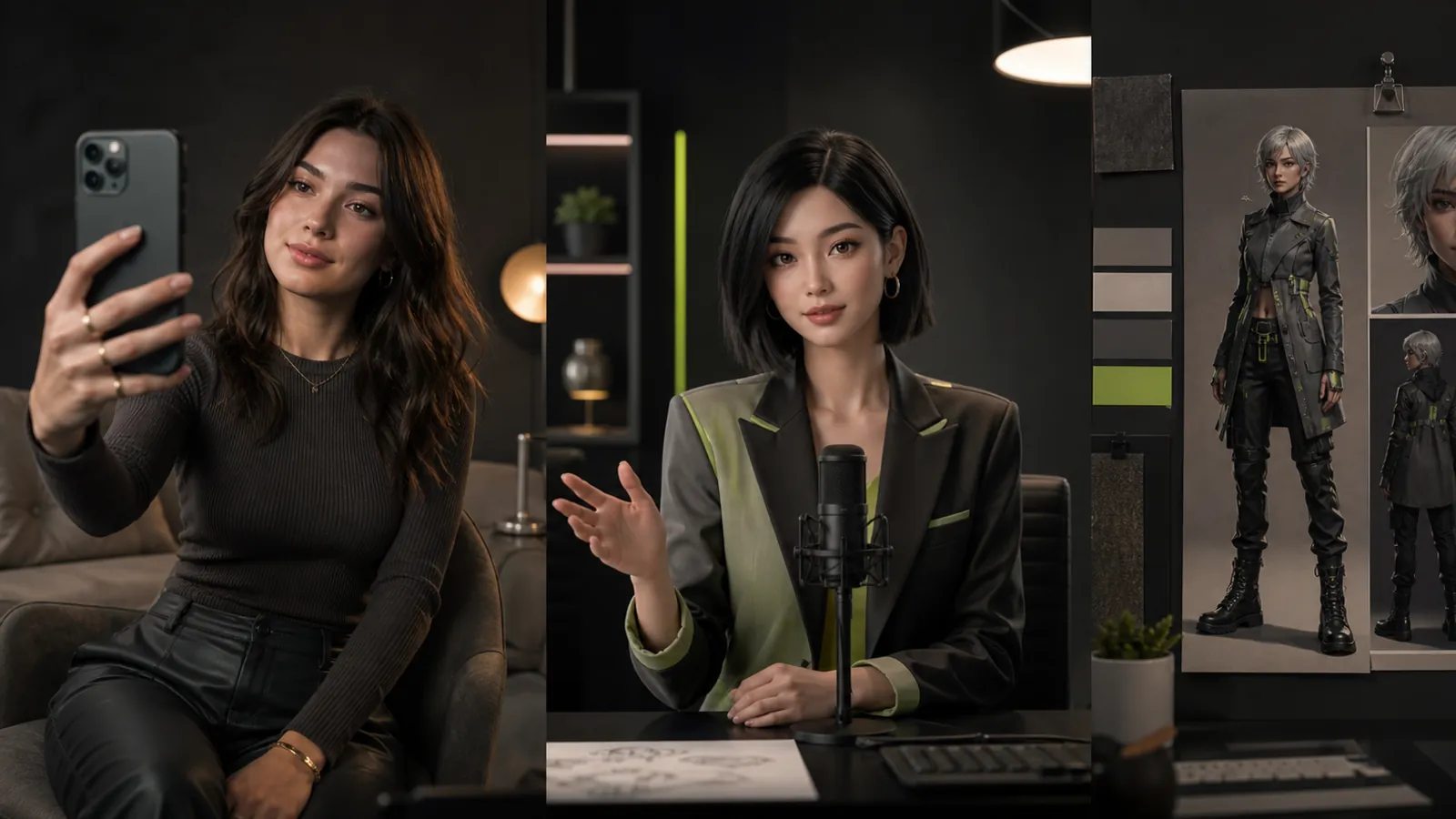
Three labels, three different jobs
AI influencer, virtual influencer, and AI character are often used as if they mean the same thing. They can describe the same project, but they answer different questions. One describes how a public-facing persona is produced, another describes the persona’s relationship to the physical world, and the third describes a reusable fictional identity. Treating them as exact synonyms makes it harder to choose the right tools, plan a content workflow, or explain the project to collaborators.
A useful distinction starts with the job the character must perform. Does the project need an ongoing social presence? Does it need a fictional figure for a game or story? Does it need one image, or a recognizable identity that can return in many posts? Those decisions matter more than the label used by a product page.
A working definition of each term
AI influencer
An AI influencer is a virtual persona whose visual content or creative workflow relies substantially on AI and is designed for an ongoing audience-facing presence. The important part is not simply that an image was generated. The persona needs a recognizable identity, a content direction, and a reason to appear repeatedly across posts or campaigns.
An AI influencer project therefore includes more than image creation. It may require identity references, scene planning, an approval process, captions, disclosure decisions, an asset library, and a publishing calendar. An introduction to AI influencers can explain the broader concept, but the practical distinction is continuity over time.
Virtual influencer
Virtual influencer is the broader production-neutral term. It describes a public-facing persona that is not a conventional human creator appearing as themselves. The character might be built with illustration, 3D graphics, compositing, AI generation, or a combination of methods. AI can be part of the workflow without defining the entire identity.
This means every AI influencer can be considered a type of virtual influencer under this working taxonomy, but not every virtual influencer needs to be generated with AI. The label says what the audience encounters—a virtual persona—rather than exactly how each asset was made.
AI character
AI character is the broadest term. It can describe a fictional identity used in a story, game, chatbot, visual experiment, avatar, campaign, or social account. An AI character does not need followers, a publishing schedule, or a commercial purpose. It may exist in one scene or across an extended narrative.
The phrase also carries wider search intent. Someone looking for an AI character creator may want anime art, a role-playing character, a game asset, a conversational agent, or a realistic persona. That ambiguity is why the term should not automatically be treated as a synonym for AI influencer generator.
Side-by-side comparison
| Term | Primary focus | Continuity needed | Audience context | Typical deliverable |
|---|---|---|---|---|
| AI influencer | Repeatable content for a public persona | Usually important across posts | Social, brand, or creator audience | A stream of approved media featuring one identity |
| Virtual influencer | A public persona that is virtual rather than a conventional human creator | Usually important | Public-facing channels or campaigns | Media produced through CGI, AI, illustration, or mixed methods |
| AI character | A reusable fictional identity | Depends on the project | May be public, private, interactive, or narrative | An image, avatar, story character, or broader character system |
Where the terms overlap
A single project can legitimately use all three labels. Imagine a fictional digital person developed with AI-assisted imagery, given a stable visual direction, and used in an ongoing social feed. The asset is an AI character, the public persona is a virtual influencer, and the production workflow makes it an AI influencer project.
The overlap is useful, but it should not erase the differences. If the goal is a one-off campaign mascot, an AI character workflow may be enough. If the character must return in new poses and settings every week, identity continuity and content operations become central. If the audience will encounter the persona as a creator, disclosure, editorial voice, and publication review also become part of the system.
Choose the label from the outcome
- Use AI influencer when the goal is an ongoing, audience-facing creator identity produced with an AI-assisted workflow.
- Use virtual influencer when the production method is mixed, unknown, or less important than the fact that the persona is virtual.
- Use AI character when the project is broader than social influence or when the character may live in stories, games, avatars, or private creative work.
- Use more than one term when each describes a real layer of the project, but define them clearly instead of creating separate pages that repeat the same promise.
What the label does not guarantee
None of these terms guarantees photorealism, audience growth, commercial results, or an identical face in every output. They also do not prove that a product includes publishing, analytics, video, licensing, or marketplace features. Those capabilities must be checked individually in the current product and terms.
A category name tells you what a tool is trying to help you create. It does not replace a test of the actual workflow, outputs, limits, and rights.
For identity-focused work, review multiple outputs from the same approved reference rather than one showcase image. Change the pose, camera distance, lighting, and environment, then inspect what remains recognizable and what varies. The existing guide to character consistency offers additional context, but every generative result still needs human review.
Rights, consent, and disclosure apply to every category
The terminology does not change the responsibilities attached to the source material. Use references you own or have permission to use. Do not use a real person’s likeness without valid consent, and do not create deceptive impersonations. Projects involving a public persona also need a clear approach to disclosing AI-generated media where platforms, audiences, or applicable rules require it.
Before uploading a reference or publishing an output, review the product’s current rules. Fanerse documents its restrictions and user responsibilities in the Content Policy. A policy is only one part of responsible practice; the operator still needs to review each input and output in context.
How Fanerse fits this taxonomy
Fanerse is positioned around an AI influencer workflow: start from an authorized reference, create a creator configuration, and generate identity-guided images across new poses and scenes. The intended value is recognizable continuity, not a promise of identical results. Users choose which outputs to keep, refine, or publish.
If your goal is an ongoing virtual persona rather than an isolated image, explore the Fanerse AI influencer workflow and evaluate it against the exact content process you need. If your project is a game character, chatbot, or one-off illustration, a broader AI character tool may be the more direct category. The right term is the one that describes the work—not the one that sounds largest.

