
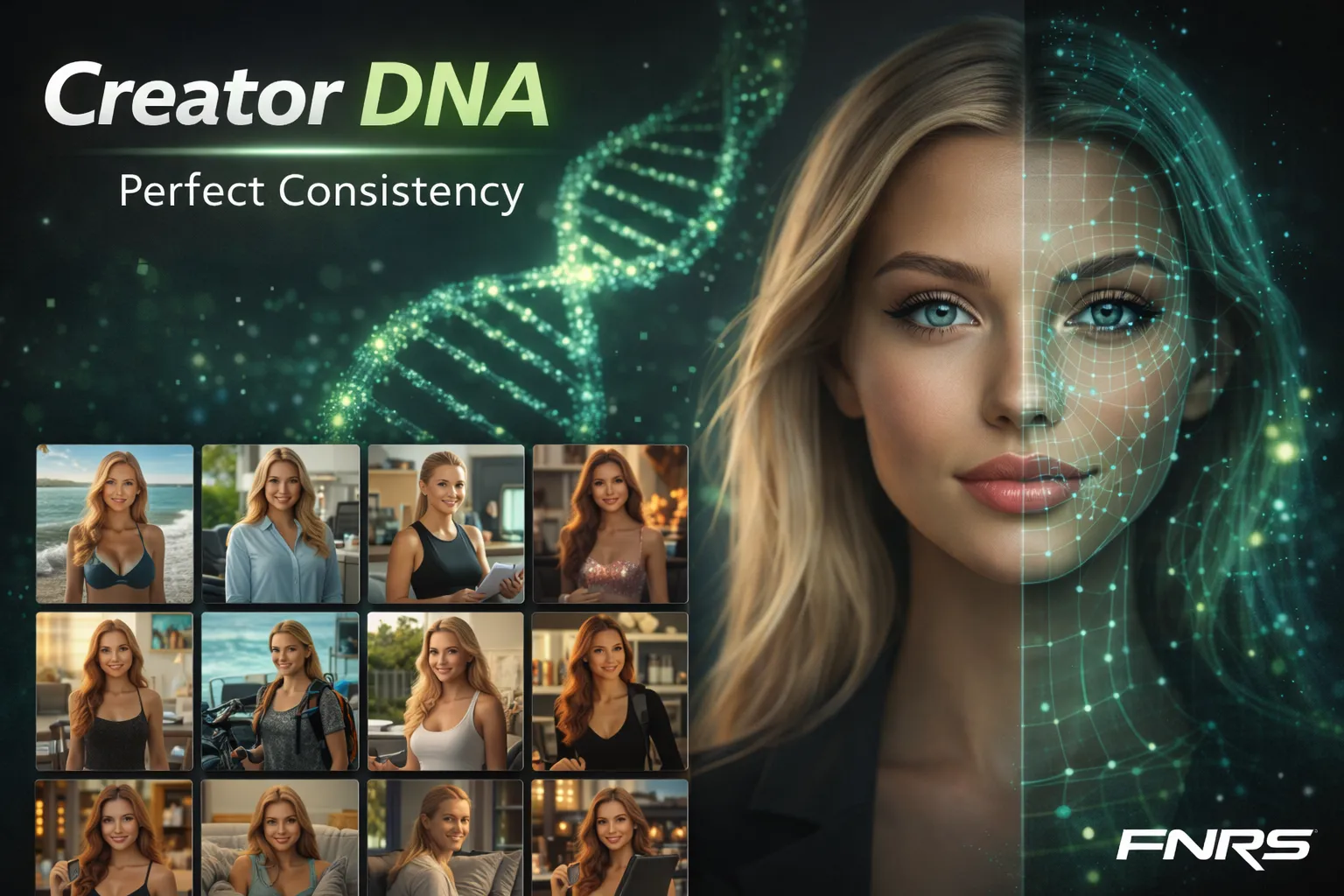
If you've ever tried generating AI images of a "character" on general-purpose platforms, you've hit the consistency problem. Generate ten images of "a brunette woman in her 20s" and you get ten different women. Different face shapes, different eye spacing, different body proportions. It's the single biggest obstacle to building an AI influencer.
Fanerse solves this with Creator DNA — a multi-layered identity system that ensures your AI creator looks like the same person in every single image, regardless of scenario, environment, or style.
How DNA Works: The Multi-Source System
Traditional AI image generation takes a text prompt and generates an image from scratch. Fanerse uses a fundamentally different approach called multi-source generation. Instead of relying on text descriptions to define your character's appearance, the system uses actual image references as anchoring sources.
Every generation on Fanerse sends multiple image references to the AI model:
- Source 1: Face reference — A dedicated face image that defines your creator's facial features, skin tone, hair color, and facial structure. This is the primary identity anchor.
- Source 2: Body reference — Either a custom uploaded body reference or a selected body preset that defines physique, proportions, and body type.
- Source 3: Scene/Environment (optional) — A reference image that defines the setting, whether it's a Persistent World room, a Reference Library asset, or a custom scene.
The AI model receives all three sources simultaneously and composes them into a single coherent image. Your creator's face and body remain consistent because the same reference images are used every time. The scene changes, the outfit changes, the pose changes — but the person stays the same.
Face References: The Identity Anchor
The face reference is the most critical component of DNA. It's stored as a creator asset and used in every single generation for that character. The AI analyzes not just the overall appearance but the specific geometric relationships between facial features — the distance between eyes, the nose-to-mouth ratio, the jawline angle, the forehead proportions.
This is why a Fanerse creator maintains their identity even in dramatically different scenarios. Whether they're wearing sunglasses, looking away from camera, in harsh lighting, or shot from an unusual angle, the underlying facial geometry carries through because the face reference is always present in the generation pipeline.
Body Presets: The Physical Foundation
Consistent body appearance is often overlooked by other platforms — they focus on face consistency and let the body vary randomly. Fanerse treats body consistency as equally important.
Body presets define your creator's physique: body type, proportions, height impression, and physical characteristics. Combined with the face reference, this creates a complete physical identity that remains stable across all content.
The practical impact is significant. When your creator is in a gym scene, their body proportions match their bedroom scene. When they're in a swimsuit, their physique is consistent with what was shown in a fully clothed office scene. This cross-scenario physical consistency is what makes an AI character feel like a real person rather than a series of randomly generated images.
The Prompt Layer
On top of the visual reference sources, every generation includes a text prompt that defines the scenario, outfit, action, and mood. But unlike platforms where the prompt is the only input, on Fanerse the prompt operates within the constraints set by the DNA references.
This means you can write creative, varied prompts without worrying about losing your character's identity. The prompt controls what's happening in the image. The DNA controls who is in the image. They work independently.
And with the Reference Library and Director Mode, you often don't need to write prompts at all. Browse a reference or select filters, and the system generates the appropriate prompt automatically while keeping your DNA locked.
What Can Break Consistency (and How to Avoid It)
DNA is robust but not magic. Here are the situations where consistency can weaken, and how to handle them:
- Extreme angles — Very low or very high camera angles where the face is barely visible. Solution: use Director Mode to control POV and ensure the face is reasonably visible.
- Heavy face obstruction — Hands covering most of the face, masks, or extreme shadows. The AI needs to see enough of the reference to maintain it. Solution: avoid scenarios where the face is more than 30% obscured.
- Dramatic style shifts — Going from photorealistic to heavily stylized or artistic renders. DNA works best within photorealistic generation. Solution: stay within the photorealistic output space for character content.
DNA as Your Most Valuable Asset
Your creator's DNA is the foundation of everything — content consistency, audience recognition, brand value, and monetization potential. A well-crafted DNA that produces beautiful, consistent results across scenarios is literally a sellable asset on the Marketplace.
Take time to get it right. Test multiple reference photos. Try different body presets. Generate in varied scenarios to confirm consistency. A strong DNA setup pays dividends across every piece of content you'll ever produce with that creator.